
The Partnership
Sleepless Nights & Belly Fat: The Hormonal Link
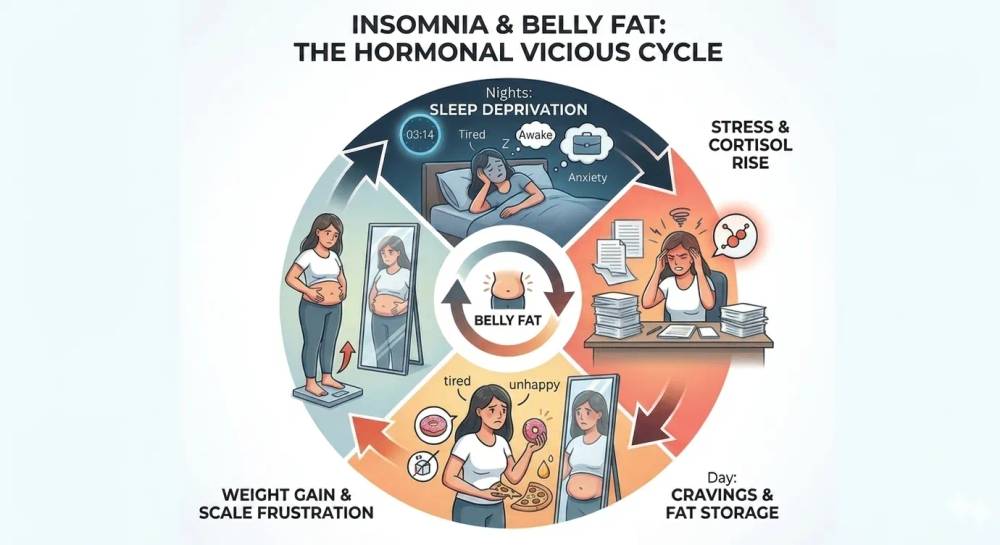
The glance at the alarm clock shows 03:14 AM, while your thoughts relentlessly race around the dense schedule of the upcoming day. The next morning, despite iron discipline during yesterday's dinner, the scale shows a few extra ounces again.
This frustrating scenario is experienced by countless women who try to lose weight through pure calorie restriction while their sleep is chronically disrupted. In this article, you will discover the exact biochemical cascade of why sleep deprivation blocks your fat burning via the stress hormone cortisol, and how you can break this vicious cycle.
The Nighttime Hormone Trap: How Sleep Disturbances Spike Your Cortisol Levels
Sleep is not a passive state, but the most important hormonal regeneration window for your entire organism. When you chronically get too little sleep or wake up frequently during the night, your central nervous system registers this condition as an acute evolutionary struggle for survival. The adrenal cortex responds by releasing increased amounts of the stress hormone cortisol to quickly provide available energy reserves for a perceived imminent danger.
Normally, cortisol follows a precise circadian rhythm: it drops continuously in the evening so that the sleep hormone melatonin can guide you into deep sleep, and it only rises again towards the morning. In the case of persistent sleep disorders, however, this level remains pathologically elevated even in the evening and deep into the night. A permanently elevated cortisol level signals your body unmistakably to rigorously protect fat reserves—preferentially in the abdominal region—for upcoming times of crisis.
Why the Body Targetedly Accumulates Fat on the Belly
Fat cells in the visceral area, meaning directly around your internal organs in the belly, possess an evolutionarily determined, particularly high density of cortisol receptors. As soon as the stress hormone binds to these receptors, lipolysis (fat breakdown) in this region is almost completely inhibited. At the same time, cortisol activates the enzyme lipoprotein lipase, which channels circulating fatty acids from the blood directly into the storage depots on the abdomen.
In my practice, I see women almost every day who, out of desperation over stagnating weight loss, eat even less or force themselves into intense cardio training. They have no idea that this behavior only drives their cortisol levels higher and cements the hormonal blockage of belly fat. The solution almost never lies in even more deprivation, but in targetingly calming the nervous system.
The Daytime Domino Effect: How Insomnia Controls Your Appetite
Unfortunately, the hormonal sabotage by no means ends when the alarm clock rings; it controls your behavior throughout the entire following day. Sleep deprivation alters the concentration of the two most important key hormones for your appetite regulation: leptin and ghrelin. While leptin is produced in fat tissue and signals satiety to your brain, ghrelin is released in the stomach and triggers acute hunger.
After just a single night of significantly shortened sleep, the protective leptin level drops measurably, while the ghrelin concentration rises drastically. The biological result is a deep-seated, biochemically driven craving that you can hardly resist with pure willpower in the long run. Following nighttime sleep deprivation, your brain instinctively demands quick energy in the form of simple carbohydrates and fats to compensate for the supposed deficit.
The DGE-Compliant Approach: Quieting Your Nervous System Through Your Plate
To sustainably break this biochemical vicious cycle, we must address two levers simultaneously: sleep architecture and blood sugar stabilization. The German Nutrition Society (DGE) emphasizes the fundamental importance of a balanced, nutrient-dense selection of foods for the body's hormonal regulation. A targeted intake of complex carbohydrates in the evening, for instance, can significantly increase the availability of the essential amino acid tryptophan in the brain.
Tryptophan is the indispensable building block for the neurotransmitter serotonin, which in the next step is converted directly into the sleep hormone melatonin. If you completely avoid carbohydrates in the evening out of diet anxiety, you often deprive your body of the biochemical foundation for a deep, undisturbed night's rest. Combined with high-quality proteins and plant-based fatty acids, you stabilize your blood sugar overnight and prevent those nighttime cortisol peaks that wake you up sweaty at 3 AM.
What This Means in Practice: Sleep Optimization Over Diet Obsession
In practice, effective weight management for highly demanded women means temporarily shifting the focus away from the scale and towards sleep quality. It brings no long-term success to keep throttling calorie intake when the foundation of nighttime hormonal regeneration has deep cracks. Only when the vegetative nervous system signals over a longer period that no acute danger is present will the organism release blocked fat reserves.
This requires a clear, reliable evening structure, a consistent reduction of blue screen light before going to bed, and intelligent nutrient timing. The key lies in removing the evolutionary fear of exhaustion or famine from the body through absolute predictability in nutrition and lifestyle.
I used to be caught in this exact trap myself: I was chronically stressed, slept miserably, and stubbornly held onto a harsh training and calorie regimen—while my belly fat stagnated. Only when I understood how cortisol was blocking my biochemistry did I pull the emergency brake, lower my workout intensity, and deliberately reintroduce complex carbohydrates in the evening. My sleep stabilized, my vegetative nervous system calmed down, and my body finally let go of the blocked fat without any starving.
The 3 Most Critical Mistakes in Sleep-Related Weight Gain
When weight stagnates despite high discipline, most women instinctively react with patterns that biochemically worsen the underlying hormonal problem. Therefore, avoid these three typical mistakes in your daily routine:
Radically cutting carbohydrates in the evening: This permanently disrupts cerebral melatonin synthesis, ensuring restless light sleep phases and nighttime cravings.
Increasing afternoon caffeine consumption: To compensate for the typical energy crash after a poor night's sleep, many women reach for coffee after 3 PM. This underestimates the biological half-life of caffeine and severely sabotages the next night's sleep.
Trying to excessively "catch up on sleep" on weekends: This completely destroys the hard-earned circadian rhythm and leads to so-called "social jetlag," which drives cortisol levels on Monday morning even higher.
What Is the Next Step?
If you recognize yourself in this vicious cycle of exhaustion, insomnia, and stagnant weight, it is time for a strategic shift in perspective. Nutrition must no longer serve as a pure instrument of punishment or restriction in your everyday life, but must be understood as a biological lever. The targeted regulation of your hormones is the only effective key to a healthy body weight and lasting mental performance.
To dive deeper into the connections between the psyche and blocking behavioral patterns, read our article on why emotional patterns block your diet. If you want to understand just how strongly your diet controls your entire hormonal balance, we recommend our scientific guide on hormones and weight loss resistance.
You now understand that your blocked weight loss is not a lack of discipline, but the logical biochemical consequence of chronic sleep deprivation and an elevated cortisol level.
Yet, pure theoretical knowledge does not break this deep-seated hormonal vicious cycle in a stressful daily routine—it requires a precise strategy tailored to your individual blood values and commitments.
In my exclusive 12-week 1:1 coaching, we analyze your specific stressors, optimize your nutrient intake according to scientific DGE standards, and develop a routine that reactivates your fat burning completely without restrictive hunger.