
The Psyche
Why Diets Fail: A Nutritionist’s Guide
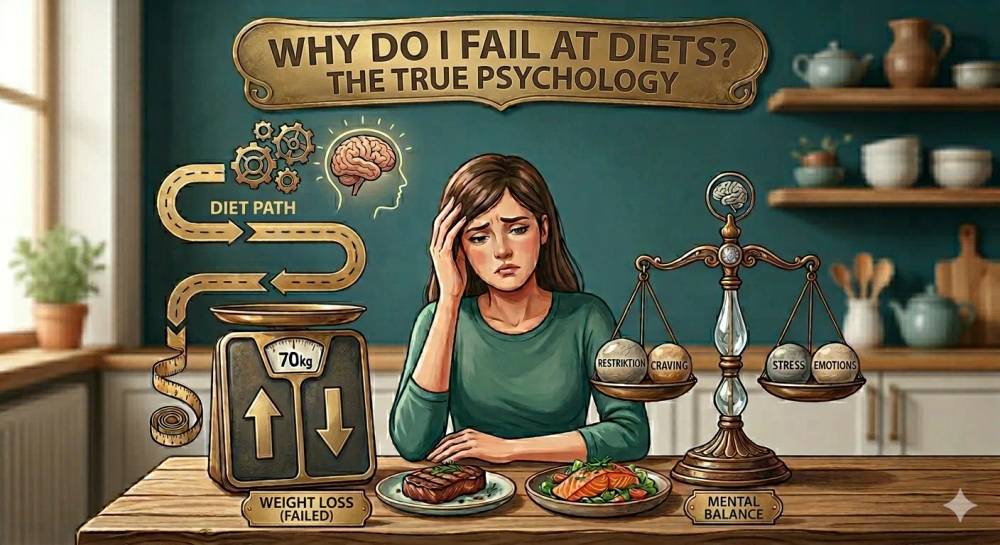
You stare at the kitchen counter, overwhelmed by a familiar wave of guilt after eating something that wasn't on your plan. You wonder why your discipline broke down yet again, convinced that you simply lack the willpower to succeed.
If you have spent years cycling between strict restriction and sudden rebounds, you are not broken, and you do not lack discipline. The uncomfortable truth is that traditional diets are psychologically and biologically engineered to fail you. To break this exhausting loop, we have to look past the plate and address the underlying behavioral mechanics of how your mind and body respond to scarcity.
The Endless Loop: When Discipline Fails at the Refrigerator Door
Most high-achieving women approach nutrition with the same rigid control they apply to their professional lives. When a new diet demands an overhaul of your daily routine, you rely heavily on executive function and mental stamina to stay on track.
This works perfectly for the first two weeks while motivation is high and stress levels remain predictable. But the moment life interferes - be it a demanding week at work, a sick child, or poor sleep - that rigid control shatters.
Particularly successful women, who manage everything flawlessly in their careers and daily lives, experience the breakdown of dieting as uniquely painful. This occurs because they attempt to force their nutrition through sheer, rational control—a strategy that becomes biologically impossible from a psychological standpoint once stress reaches a certain threshold.
When your energy is fully consumed by managing your daily responsibilities, your brain lacks the surplus capacity required to enforce artificial dietary rules. You find yourself eating the exact foods you tried so hard to avoid, not because you lack strength, but because your mental reserves are entirely exhausted.
The Willpower Myth: Why Pure Discipline Is a Finite Resource
Willpower is not a fixed reflection of your character; it operates much like a muscle that tires after prolonged exertion. Every decision you make throughout the day—from answering emails to managing family logistics—draws from the exact same cognitive reserve.
When your nutritional strategy relies entirely on constantly denying your internal cues, you force your brain into a state of perpetual decision fatigue. By the time evening arrives, your capacity to resist external temptations or internal urges is significantly diminished.
The Restriction-Rebound Effect: How Deprivation Triggers Cravings
When you completely banish a specific food group or declare a ingredient entirely off-limits, your brain instantly heightages its focus on that exact item. This is known in cognitive psychology as the ironic process theory: the more actively you try to suppress a thought, the more prominent it becomes.
This psychological hyper-focus transforms a simple preference into an intense, urgent craving. Eventually, the psychological pressure builds to a point where a rebound becomes inevitable, often leading to overeating the very food you attempted to restrict.
The Evidence-Based Reality: Sustainable Habits over Rigid Rules
From the perspective of evidence-based nutritional science - as advocated by the German Nutrition Society (DGE) - extreme crash diets are the most reliable path to the yo-yo effect. Sustainable weight regulation never succeeds through rigid, external rules; it requires a gradual modification of your behavioral eating habits.
If you want to alter your behavior for the long term, you must view your body’s biological signals as a partner rather than an enemy. Permanent weight loss is only achievable when your nutrition aligns with your life - not when you are forced to painstakingly construct your entire life around a diet.
Emotional Compensation: What the Scale Completely Ignores
Food is fundamentally intertwined with our emotional lives, serving as a reliable mechanism for comfort, stress relief, and celebration since childhood. When a rigid diet strips away food as a coping strategy without providing a sustainable alternative, your emotional resilience declines.
During periods of high stress, your brain seeks immediate comfort and safety, frequently defaulting to highly palatable, energy-dense foods that trigger a rapid dopamine release. If your nutritional plan fails to account for these emotional needs, it leaves you completely defenseless against stress-induced eating patterns.
A busy professional who starved himself during the day, only to face uncontrollable emotional eating at night due to accumulated stress. Once we shifted his focus from restriction to adequate daytime nourishment and stress management, his evening binging subsided entirely without relying on willpower.
3 Toxic Mindsets That Destruet Your Progress (And How to Fix Them)
To build a genuinely sustainable relationship with food, you must first identify and dismantle the cognitive distortions that actively sabotage your consistency.
The All-or-Nothing Dichotomy: Categorizing days as either completely perfect or entirely ruined ensures that a minor deviation transforms into a multi-day cycle of overeating.
Moralizing Food Choices: Labeling foods as inherently good or bad causes you to internalize those judgments, leading to profound food guilt and shame whenever you deviate from your plan.
Chasing Immediate Metrics: Relying solely on daily weight fluctuations ignores natural fluid shifts and hormonal cycles, causing unnecessary frustration and premature abandonment of your goals.
Real progress relies on replacing these rigid structures with flexible, identity-based habits that allow you to navigate real-life situations without ever feeling like you have failed.
What Is the Next Step?
To permanently break this vicious cycle, you must learn to deeply understand and resolve the dynamics of your eating behavior. If you are ready to shift your perspective, our comprehensive guide offers valuable insights on how to build a healthy relationship with food.
Additionally, our deep dive reveals concrete, psychologically proven strategies to stop the automatic urge to snack during stressful times: How to Stop Emotional Eating: Psychological Strategies.
You now understand that sustainable health is never built on a foundation of deprivation, and that your past struggles were the result of flawed dieting frameworks rather than personal shortcomings. However, transferring this structural knowledge into lasting daily habits requires a highly personalized, expert strategy that respects your unique lifestyle and biology.
The 12-week 1:1 coaching journey is designed specifically for professional women who want to break the restriction cycle, balance their physiology, and build lasting food freedom through evidence-based behavioral psychology.