
The Vessel
Hormones & Nutrition: Why You're Not Losing Weight Despite a Deficit
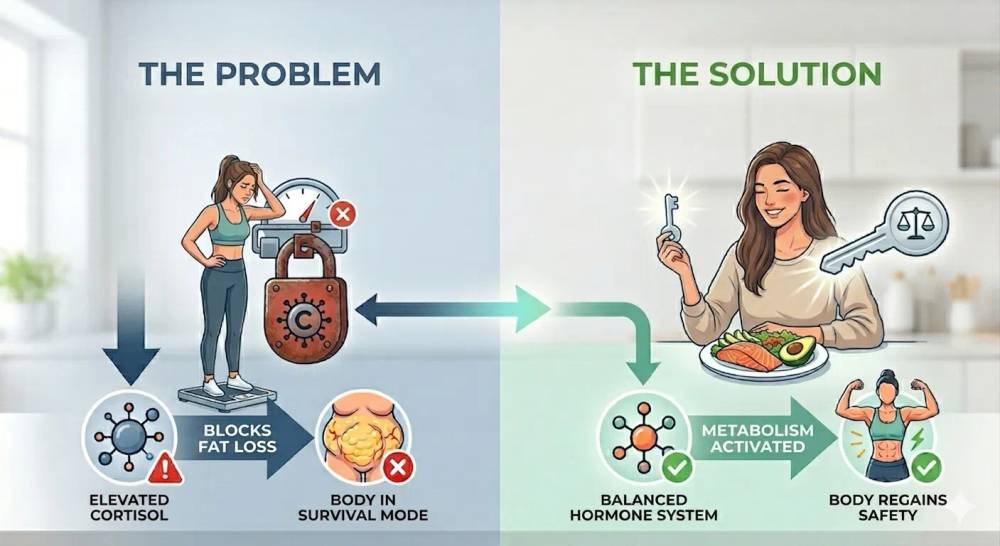
You track every single calorie meticulously, train with deep discipline, and yet the scale refuses to budge a single millimeter. This frustrating plateau is rarely a lack of willpower; it is a profound biochemical blockade operating within your body.
When your hormonal system is thrown out of sync, your organism switches into pure survival mode and holds onto every ounce of fat tissue with striking tenacity. In this article, you will discover how the biological axis between hormones and nutrition functions, why extreme deficits worsen the issue, and how to strategically rebalance the key messenger substances: cortisol and estrogen.
The Invisible Network: How Hormones and Your Nutrition Are Linked
Your body is not a simple calculator for calories, but a highly complex, hormonally regulated system. Every food you consume does not just provide raw energy, but sends immediate biochemical signals straight to your endocrine glands. The type and quality of your nutrition dictates whether your body receives systemic signals for fat burning or fat storage.
When this delicate network is disrupted by chronic nutrient deficiencies or ongoing psychological stress, even the largest theoretical calorie deficit becomes entirely useless. Within our biological hierarchy, the hormonal system always holds absolute priority over mathematical energy balances.
Vitamins, minerals, and macronutrients are not just fuel; they directly control the secretion of primary hormones like insulin, leptin, and thyroid markers. If these essential building blocks are missing due to a permanently restrictive diet, the brain automatically dampens your overall metabolic rate. Your body tries at all costs to protect its valuable energy reserves for vital organ functions.
Cortisol – The Stress Hormone as an Evolutionary Fat-Burning Brake
Cortisol is an essential life-sustaining hormone produced in the adrenal cortex to provide rapid energy during acute danger. In our modern, performance-driven society, however, this evolutionary alarm state is frequently active around the clock.
As soon as we face ongoing psychological pressure, the adrenal glands continuously flood the bloodstream with cortisol. This evolutionary mechanism was originally designed to prevent us from losing valuable energy during periods of starvation or physical flight. In today's hectic work and family life, this permanent activation ensures that fat breakdown is systemically blocked.
The Chronic Alarm State and Belly Fat Storage
Constantly elevated cortisol levels signal to the body that an existential crisis or famine is looming. To prepare for this threat, the hormone blocks fat breakdown and actively promotes the storage of visceral fat right in the abdominal area. Chronic stress combined with a severe calorie deficit drives your cortisol levels to heights that make fat burning biologically impossible.
In my practice, I constantly see highly ambitious women who survive on coffee in the morning, train extremely hard, and simultaneously face non-stop pressure at work. This toxic triad pushes cortisol so incredibly high that the body completely blocks fat loss out of pure self-protection.
Estrogen Dominance – When Imbalance Blocks Weight Loss
Alongside the stress hormone cortisol, female sex hormones play a decisive role in systemic weight regulation. Above all, the delicate balance between estrogen and progesterone determines how efficiently your cellular metabolism operates.
The female endocrine system reacts far more sensitively to external stressors and energetic deficits than the male system. When the hormonal rhythm wavers, reproductive hormones are the very first to be down-regulated by the brain. This leads to shifts in the monthly cycle that directly affect your baseline energy levels and long-term weight management.
Why the Interplay Between Progesterone and Estrogen Rules Your Metabolism
A relative excess of estrogen compared to progesterone is known as estrogen dominance, affecting many women from their 30s onward. This imbalance frequently causes subcutaneous water retention, slowed thyroid activity, and a direct blockade of lipolysis. When estrogen balance is disrupted, the body preferentially stores energy, even if you are supposedly operating in a strict calorie deficit.
The Scientific Lever: Nutrition as a Regulator of the Endocrine System
The good news is that you are not defenseless against your hormones; you can control them through targeted nutritional frameworks. Current biochemical insights and the German Nutrition Society (DGE) guidelines show that your choice of nutrients directly influences hormone production.
For stable hormone synthesis, your body primarily requires an adequate supply of essential fatty acids and amino acids, alongside constant blood sugar regulation. A blood-sugar-stabilizing diet featuring high-quality proteins and healthy fats is the most effective foundation to prevent excessive cortisol release and restore hormonal balance.
Additionally, complex carbohydrates and dietary fibers support the excretion of excess hormones via the gut, actively counteracting estrogen dominance.
What This Looks Like in Practice
The theory of hormonal blockades is best understood when observed in real, day-to-day life. Many women attempt to solve a hormonal issue with even more severity toward themselves, which only destabilizes their biochemistry further.
A client, in her mid-50s and in the midst of menopause, was making zero progress losing belly fat despite regular exercise and a highly conscious diet. Instead of slashing calories further, we optimized her intake of essential fatty acids and adjusted a few strategic details. Her body rediscovered its signal of safety, the hormonal plateau broke open, and she lost 6 kilograms completely stress-free.
The 3 Most Common Mistakes in Hormonal Weight Loss Plateaus
When weight stagnates despite intense discipline, most women react with the exact same, counterproductive patterns. These mistakes usually worsen the hormonal imbalance drastically:
Eating even less: Radical crash diets mean pure existential stress for the organism and cause cortisol levels to explode.
Excessive cardio without recovery: Hours of endurance training during an existing energy deficit signal an emergency, causing the body to massively lower its basal metabolic rate.
Unverified supplement intake: Randomly consuming chasteberry, wild yam, or hormonal supplements without a precise prior status-quo analysis often causes more harm than good.
What's the Next Step?
To sustainably liberate your metabolism, you must stop fighting your body and start working with your biology. If you feel that your hormonal axis is completely blocked, you need to understand why your metabolism seems to be completely at a standstill. At the same time, it is crucial to learn how to reclaim your energy and vitality alongside this process, to finally break the vicious cycle of exhaustion and stagnation.
You now understand that your blocked weight is not proof of a lack of discipline, but the biological result of a disrupted hormonal network ruled by cortisol and estrogen. However, pure theoretical knowledge about hormones will not dissolve your body's biochemical protective shield as long as you lack the exact strategy tailored to your real life. If you are ready to leave the endless cycle of dieting behind and systematically rebuild your metabolism step-by-step on a scientific foundation, I invite you to apply for my exclusive 12-week 1:1 coaching program.