
The Psyche
Why Do I Have Food Cravings? The Psychology Behind Them
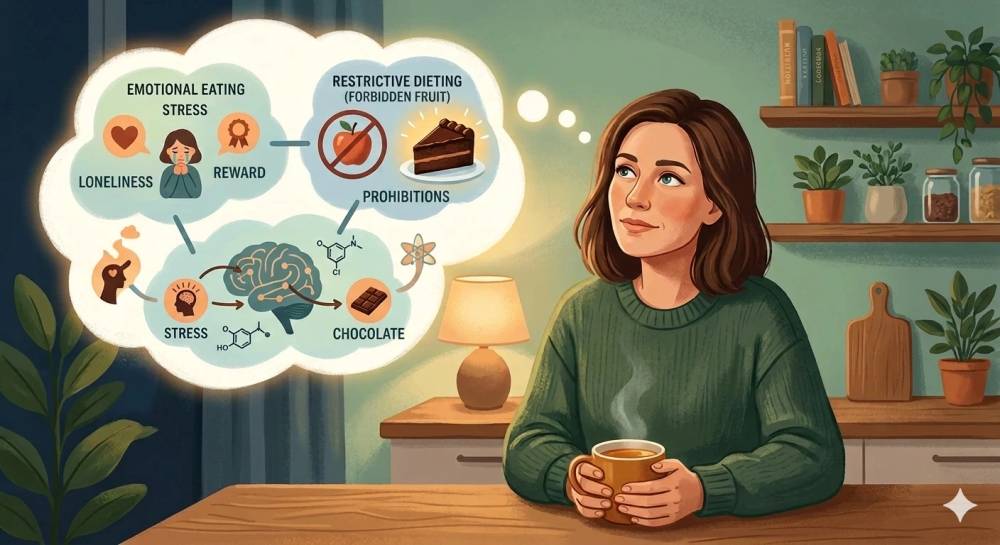
It is 9:00 PM, the day was long, and suddenly it hits: that uncontrollable urge for something sweet or salty. You aren't actually hungry, yet your brain seems to steer you directly to the pantry as if you’ve lost control over your own movements.
This feeling of being at the mercy of your own impulses is a daily reality for many women between 30 and 55, and it is often accompanied by deep-seated shame. We tend to believe we lack discipline or willpower, but in reality, cravings are highly complex signals from your nervous system. In this article, we decode what your mind is truly trying to communicate and why the battle against cravings begins in the grocery aisle but is won through psychology.
Cravings Are Not a Sign of Weak Character
The most important message first: Your body is not trying to sabotage you. Cravings are a form of communication—a biological and psychological response to an imbalance.
When we view cravings as an enemy, we usually react with more restrictions and stricter rules. However, this only intensifies the stress cycle that triggered the cravings in the first place. Cravings are not a lack of willpower; they are a signal of an unresolved need within your system.
The 3 Primary Psychological Reasons for Your Desires
Why does your brain demand chocolate when you are stressed, rather than broccoli? The answer lies deep within our neural reward pathways and learned behavioral patterns.
Emotional Eating as an Unconscious Protective Mechanism
Eating is the fastest and easiest way to regulate our nervous system. Sugar and fat stimulate reward centers in the brain, triggering a short-term release of endorphins.
Often, we use food to "numb" feelings like loneliness, overwhelm, or boredom. At the moment you reach for that chocolate, your system is actually searching for relaxation or comfort.
In my clinical observation, I often see that cravings are the result of a deep-seated "all-or-nothing" mentality. As soon as a client eats a supposedly "forbidden" food, her brain immediately switches to: "It doesn't matter anymore." This artificially created pressure and the subsequent impulse of shame are what turn a small moment of indulgence into the loss of control we perceive as a binge. True freedom begins when we dissolve the moral valuation of food.
The "Forbidden Fruit" Syndrome: How Restriction Fuels Cravings
When you categorically forbid yourself certain foods, your brain categorizes them as particularly precious and desirable. Psychologically speaking, deprivation creates a form of cognitive scarcity.
The more you try not to think about a slice of pizza, the more space it occupies in your consciousness. This mental pressure eventually discharges in an uncontrolled eating episode that goes far beyond actual hunger.
The Dopamine Trap: Your Brain in Search of Reward
Our brains are hardwired to prefer high-energy foods, as this ensured survival in the past. Today, food manufacturers use this knowledge to create products that hit the so-called "bliss point."
These foods trigger such a strong dopamine response that your brain stores a shortcut: "When I feel bad, I need Product X to feel safe." This creates a highway in your mind that automatically leads to the same "solution" every time a stress signal appears.
The Vital Difference: Physical Hunger vs. Emotional Hunger
To break the cycle, you must learn to differentiate your body's signals. Emotional hunger usually strikes suddenly and demands a very specific food item.
Physical hunger, on the other hand, develops gradually and is patient—a balanced meal would suffice here. While physical hunger is felt in the stomach, emotional hunger exists almost exclusively in the mind as a diffuse, urgent drive.
The Physiological Component: What the Science Says
Although psychology is the driving force, we cannot ignore the physiological basis. According to DGE (German Nutrition Society) guidelines, maintaining a stable blood sugar level is paramount.
If you consume too little energy throughout the day or skip meals, your blood sugar drops into a critical zone. Your brain panics and demands quick carbohydrates to secure energy supply—your psychological resilience drops to zero in this state.
Strategies for Regulation: Breaking the Cycle Psychologically
How do we handle it when cravings strike? The key lies not in suppression, but in curiosity.
Ask yourself in that moment of desire: "What do I actually need right now?" Is it rest, validation, a break, or actual nourishment? Often, simply sitting with the urge for five minutes and breathing deeply can calm the sympathetic nervous system (fight or flight).
A client in his early 30s with a high-pressure career was convinced he was "addicted to sugar" because he needed a whole bar of chocolate every evening. Through our work, we discovered the chocolate was his only moment of autonomy and reward in a completely externally determined schedule. Once he learned to build "micro-breaks" for his nervous system during the day and set clear boundaries at work, the sugar lost its function as an emotional emergency anchor. Today, he enjoys chocolate consciously - but the drive to lose control has vanished.
Common Mistakes: What Doesn’t Work (And Why)
The biggest mistake is trying to fight cravings with even more discipline. This is like trying to put out a fire with gasoline.
Substituting "unhealthy" cravings with "healthy" alternatives (e.g., a date instead of chocolate) also only works short-term. If the psychological root—such as stress relief—is not addressed, the system remains in a state of deficiency.
True freedom from cravings doesn't come from better substitute products, but from resolving the emotional connection.
What Is the Next Step?
Understanding cravings is the first step toward making peace with your body. It’s not about never eating chocolate again; it’s about having the power of choice instead of being driven by impulses.
If you are ready to explore the deeper causes of your eating behavior, you should explore the concept of intuitive eating. Learn more here about what intuitive eating is and how it works.
Equally important is creating routines that support your nervous system before cravings even arise. Read our guide on how to build healthy eating habits without willpower.
Your Path to a Peaceful Relationship with Food
You now understand that your cravings are not a failure, but a message from your body regarding unresolved needs. However, knowledge alone is often not enough to break years of ingrained patterns on your own.
If you want to end the constant battles in your head and finally find a way of eating that feels light and natural, I would love to support you. In my 12-week 1:1 journey, we get to the root of your cravings and build a foundation based on science and self-care.