
The Psyche
Intuitive Eating: Your path out of yo-yo dieting & cravings.
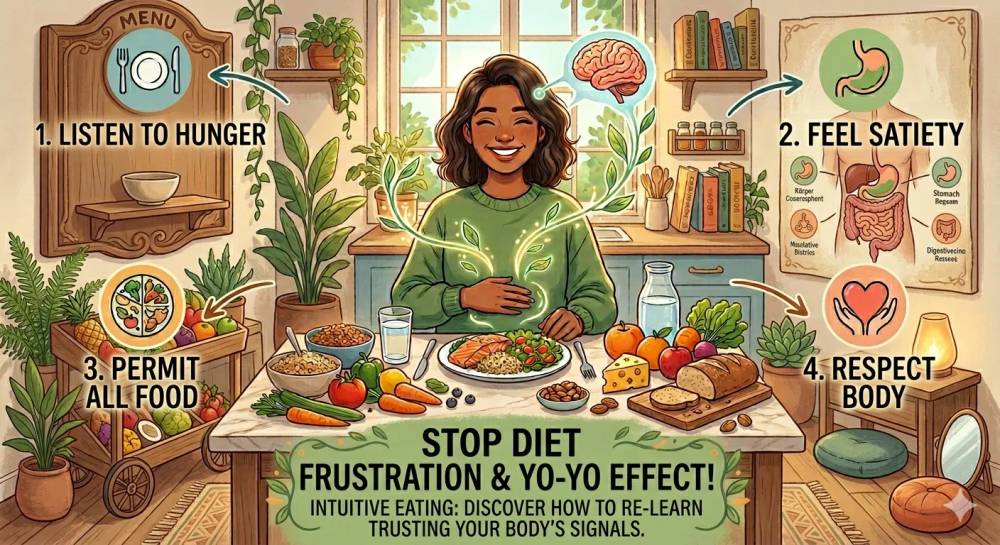
You’re tired of counting calories, but the fear of losing control keeps you up at night. You find yourself wondering: "If I stop controlling everything, will I ever stop eating?"
Most of my clients come to me at a point where they feel betrayed by their own bodies. They’ve tried every diet imaginable, only to end up heavier and more exhausted than before. Intuitive eating isn’t just another diet; it’s the unlearning of rules that have made you sick.
What is Intuitive Eating, Really?
Intuitive eating is often misunderstood as "just eat whatever you want, whenever you want." In a world full of highly processed foods and constant stress, that is not helpful advice.
Instead, it is an evidence-based framework that helps you reconnect your brain and your stomach. It’s about distinguishing biological hunger from emotional hunger.
Rather than following external rules (like "no carbs after 6 PM"), you learn to listen to your body’s internal signals. The goal is flexible, enjoyable nutrition without the guilt.
Why Diets Fail: The Anatomy of the Yo-Yo Effect
When you follow a restrictive diet, your body enters survival mode. Your metabolism slows down, and your hunger hormones—most notably ghrelin—spike massively.
The yo-yo effect isn’t a lack of willpower. It’s your body’s biological defense mechanism against a perceived famine.
Once the diet ends, this hormonal cocktail ensures you eat more, while your body stores every calorie more efficiently. Intuitive eating breaks this cycle by restoring physiological safety.
I often see women in my work who blame themselves for the yo-yo effect. But it’s actually proof that your biological survival system is working perfectly. We just have to teach your body to feel safe again, rather than deprived.
The Science Behind Cravings
Cravings are often the result of physical or psychological restriction. When you forbid yourself from eating certain foods, they become "hyper-relevant" in your brain.
As soon as you finally give in, the brain switches to "all-or-nothing" mode. This is known as the "Last Supper Effect."
Intuitive eating strips food of its moral power. When chocolate is fundamentally allowed, it loses the allure of the "forbidden fruit" and, with it, the power to trigger an uncontrollable binge.
The Pillars of Intuition: Sensing Hunger and Fullness
The first step back to intuition is awareness. Over decades, many women have lost the ability to sense what real, biological hunger feels like.
- Biological Hunger: Builds up slowly, is felt in the stomach, and can be satisfied by a variety of foods.
- Emotional Hunger: Comes on suddenly, is often felt "above the neck" (in the head), and usually demands one specific type of food.
Learn to start eating on a scale of 1 to 10 when you are at a 3 or 4, and stop when you reach a comfortable 7. It sounds simple, but it requires mindfulness and practice.
What This Concept Means in Practice
Intuitive eating doesn't mean that nutritional values no longer matter. As a DGE-certified nutritionist, I know how vital biochemistry is.
However, it means the decision-making power lies with you. You don’t eat the salad because you "have to," but because you know it gives you energy for the afternoon.
You eat the slice of pizza without regret because you know that one meal ruins neither your health nor your weight. This freedom is the key to long-term stability.
A client’s partner stopped eating breakfast and lunch entirely to lose weight, replacing meals with 6 liters of water a day. By evening, his energy was depleted, leading to massive portions and constant headaches. By reintroducing a balanced breakfast and lunch, his weight stabilized, his nighttime cravings vanished, and he rediscovered the joy of cooking and sustained energy.
Common Mistakes: Why intuitive eating feels difficult in the beginning
The biggest error is turning intuitive eating into another diet. Rigid rules like 'only eating when hungry' simply create more stress.
In the beginning, your body might crave all the things you’ve forbidden for years. This is the 'honeymoon phase'.
Have faith that your appetite will level out once your body realizes that the cycle of 'famine'—or dieting—has ended. Overwriting years of conditioning requires time and patience.
What’s the Next Step?
Knowledge alone doesn't heal a distorted relationship with food. Navigating the diet labyrinth often requires guidance that understands both the physiological and psychological pitfalls.
If you want to understand why your body has reacted the way it has, I recommend my article on the Psychology Behind Cravings.
Would you like to learn how to identify specific emotional triggers? Then take a look at my strategies to stop emotional eating sustainably.
Making Peace With Your Body
You now understand that your body is not an enemy to be tamed, but a partner you can communicate with. Intuitive eating is the tool to seal this partnership and leave the yo-yo effect behind for good.
But theory is no substitute for an individual strategy that accounts for your hormones, your daily routine, and your history. If you’re ready to end the constant mental loop around food and want an expert by your side to lead you safely through this transformation, let’s talk.