
The Partnership
Health Insurance Covers Nutrition Counseling? The Honest Cost Check
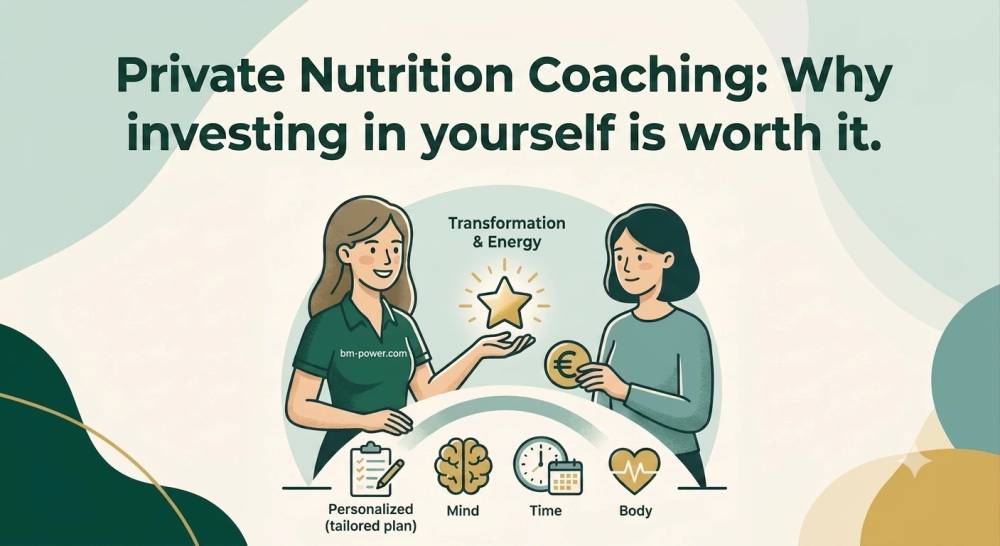
Are you ready to sustainably transform your diet, but wondering what costs lie ahead? Uncertainty around finances and insurance reimbursement stops many women from seeking professional guidance.
In this article, you will get a clear breakdown of what statutory health insurance actually covers, where standard coverage falls short, and why investing in private 1:1 coaching is often the most effective commitment to your long-term health.
Does Health Insurance Cover Nutrition Counseling?
Statutory health insurance providers generally divide care into two main categories. The distinction determines whether and how much funding you might receive.
- Prevention (§ 20 SGB V): Aimed at healthy individuals looking to prevent weight gain or improve their general diet. Coverage is usually restricted to standardized group courses or certified online programs. ***
- Medical Nutrition Therapy (§ 43 SGB V): If a medical condition is diagnosed (e.g., IBS, obesity, food intolerances), insurers provide a medical subsidy based on a doctor's certificate of necessity.
Important: Health insurance providers exclusively subsidize advisors with specific association certifications (e.g., DGE, VFED) and operate within very rigid, predetermined frameworks.
The Limits of Insurance Coverage: Why Standard Counseling Often Isn't Enough
An insurance subsidy sounds tempting, but in practice, it usually covers only a few isolated sessions or oversimplified group classes.
Pure factual knowledge about nutrients and calories is rarely enough to break deeply ingrained daily habits. Practical experience shows that standard insurance-covered counseling hits clear boundaries:
- Rigid Frameworks: Insurance-compliant sessions must strictly follow standardized templates. There is little space for individual real-life schedules, hormonal imbalances, or emotional eating.
- Lack of Time: Deep behavioral change cannot be achieved within just 3 to 5 subsidized sessions.
- Symptom vs. Root Cause: The focus remains on eating behavior on paper, rather than addressing the underlying psychological and emotional triggers.
From my practice, I know that women rarely fail due to a lack of knowledge. They usually know exactly what is 'healthy.' What is missing is guidance that operates without rigid insurance templates to address individual behavioral patterns in daily life.
What Does Private Nutrition Coaching Cost for Self-Payers?
Choosing private nutrition counseling or exclusive coaching means investing directly in your own quality of life.
Depending on the intensity, duration, and scope of support, qualified 1:1 coaching typically ranges between €100 and €200 per individual session, or is offered through comprehensive multi-month programs.
Paying privately gives you complete independence from bureaucratic applications, waiting lists, and the constraints of the healthcare system.
Insurance Coverage vs. Private 1:1 Coaching: A Direct Comparison
Subsidized Insurance Counseling
Billing: Applications & medical certificates required
Focus: Information transfer & diet therapy
Flexibility: Bound to rigid insurance curricula
Support: Isolated appointments weeks apart
Private 1:1 Coaching (bm-power)
Billing: Direct & hassle-free
Focus: Behavioral psychology, mindset & body
Flexibility: 100% tailored to your daily life
Support: Continuous 1:1 support over several weeks
Why Investing in Yourself Pays Off in the Long Run
Engaging in private coaching as a self-payer is a conscious choice for your health and future.
Instead of quick fixes or cookie-cutter diets, you invest in a system that restores sustainable energy, physical well-being, and mental peace.
One of my clients spent months dealing with bureaucratic applications for insurance courses that ended up just repeating old diet rules. Only when she decided to invest in targeted 1:1 behavioral coaching as a self-payer did she permanently resolve her emotional eating.
Common Misconceptions About Costs
- "Insurance covers it, so it must be the best option": Subsidized services are tied to minimal standards that often lack the depth needed for true behavioral change.
- "Paying privately is too expensive": Consider the hidden costs of yo-yo dieting, wasted money on miracle products, and years of lost quality of life.
- "I need a medical diagnosis first": In private coaching, you don't have to get sick first to receive professional support for your body.
Deciding Which Path Is Right for You
To understand how private coaching fits into your financial planning, read our article on how much a nutrition coach costs and whether it's worth it.
If you want to understand who is best equipped to support your goals, take a look at the difference between a nutritionist and a dietitian.
You now understand how billing works and why choosing the private route guarantees maximum quality, personalization, and freedom.
However, knowledge alone won't transform your daily life. To sustainably adapt your nutrition, stop cravings, and regain your full energy, you need support tailored precisely to your reality. In my 12-week 1:1 coaching journey, we combine scientific standards with grounded behavioral psychology - completely free from rigid insurance constraints.