
The Vessel
Stop Sabotaging Your Weight Loss: 5 Healthy Eating Mistakes
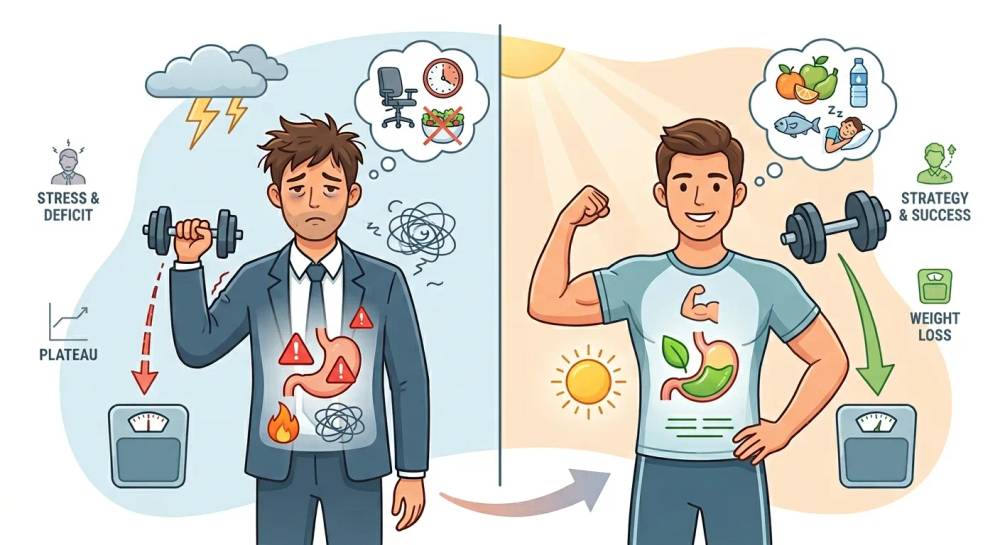
You are doing everything right, skipping fast food, and choosing unprocessed, whole foods. Yet, the scale refuses to budge, and your daily energy is completely tanking.
It is incredibly frustrating when disciplined behavior goes unrewarded and your body feels like it is actively working against you. The reality is that eating healthy is the baseline for vitality, but it does not automatically protect you from hidden physiological and strategic missteps.
The Paradox of "Healthy" Eating: Why Restriction Often Blocks Progress
Many ambitious professionals in high-stress careers fall into the exact same trap. They define nutrition strictly through restrictions and food quality, completely losing sight of energy balance and their hormonal response. Trying to force weight loss through pure willpower and "clean eating" almost always guarantees a metabolic plateau.
Nutrition is not a moral compass of "good" versus "bad" foods; it is pure biochemistry. If you supply your body with nutrient-dense foods but do so without structure or in the wrong ratios, it triggers survival mechanisms instead of burning fat.
In my coaching practice, I constantly see high performers caught in a trap of chronic underfueling. They slash calories out of fear of gaining weight, even though their demanding schedules require peak cognitive and physical energy. This mismatch forces the body into an evolutionary energy-saving mode, fiercely defending every single fat cell while leaving them chronically exhausted.
In my daily work, I constantly see women over 40 caught in a chronic underfueling trap. Out of fear of gaining weight, they slash calories lower and lower, even though their highly demanding daily routines—balancing career and family—require peak energy output. The result is not fat loss, but a hormonal emergency state where the body fiercely defends every single energy reserve while chronic exhaustion sets in.
The 5 Most Common Weight Loss Nutrition Mistakes
To break through this plateau, we have to expose the invisible mechanisms sabotaging your results. Here are the five most underestimated mistakes I observe daily in my clients.
1. The "Healthy-But-Calorie-Dense" Trap
Nuts, avocados, extra virgin olive oil, and wild salmon are incredibly nutritious, packed with essential fatty acids and micronutrients. However, they are also highly energy-dense. Consuming these foods without an awareness of their actual caloric footprint can easily push you past your daily energy expenditure before you even feel full.
2. Living in a Chronic Deficit and the Hormonal Backlash
The exact opposite approach is just as damaging: maintaining a drastic calorie deficit for too long. When you consistently eat far below your basal metabolic rate, your body downregulates its energy expenditure. Thyroid hormone conversion slows down, cortisol levels spike, and your metabolism hoards energy out of self-defense.
3. Focusing on Elimination Instead of Nutrient Density
Cutting out entire food groups, like complex carbohydrates, generates massive psychological stress and biochemical cravings. The key to sustainable fat loss is never about subtraction; it is about the strategic addition of satiating elements. Missing out on dietary fiber and high-quality protein signals constant deprivation to your brain.
For individuals operating under high daily stress, an aggressive low-carb approach often creates a physiological emergency. Carbohydrates are essential for converting thyroid hormones into their active state and regulating the stress response. Eliminating them entirely triggers intense cravings and halts efficient fat loss.
4. Overlooking Liquid Calories and Mindless Snacking
The splash of oat milk in your multiple daily coffees, a healthy fruit smoothie, or a seemingly light salad dressing add up rapidly. These unnoticeable liquid calories and bites create frequent insulin spikes, which consistently put the brakes on fat oxidation without providing any lasting satiety.
5. Protein Deficiency Despite a Seemingly Balanced Diet
Protein possesses the highest thermic effect of food and protects lean muscle tissue during a caloric deficit. Many individuals simply do not consume enough protein, wondering why they lose muscle definition and strength instead of actual body fat. Inadequate protein intake is the leading cause of persistent hunger during weight loss.
The Physiological Perspective: Science-Backed Weight Management
Established nutritional guidelines highlight the absolute necessity of a well-balanced, sufficient intake of all macronutrients. Sustainable fat loss relies entirely on a moderate, calculated negative energy balance that nourishes the organism rather than draining it.
When essential amino acids and micronutrients are missing, mitochondrial activity — the actual power plants of your cells — declines. The consequence is not true fat loss, but rather the degradation of metabolically active muscle tissue and a profound drop in daily energy.
Turning Mistakes into Sustainable Systems: The Mechanics of Change
Breaking free from this cycle does not require another restrictive diet plan. What you truly need is a clear, data-driven baseline of your actual intake paired with a nutritional structure that respects your biological rhythm.
A client of mine, a mid-30s manager, came to me completely burned out. He was meticulously tracking every leaf of spinach, skipping meals during hectic workdays, and eating under 1,500 calories while trying to lift heavy weights — yet he kept gaining body fat around his midsection. Through coaching, we strategically raised his daily caloric intake and restructured his macronutrients to match his high-stress career. His body relaxed, his professional focus returned, and he finally dropped body fat while preserving his hard-earned muscle.
The moment you stop fighting your biology and start strategically nourishing it, your weight naturally stabilizes. This shifts your relationship with food from emotional stress to long-term freedom.
What Is Your Next Step?
If you feel lost in a maze of conflicting nutritional rules, it is time for an objective, expert evaluation. Often, it is the microscopic, unseen adjustments in your daily routine that yield the most profound breakthroughs.
Learn more about how a nutrition professional uncovers hidden dietary problems, to fast-track your progress. If you want to master the fundamental mechanics of energy distribution, read our deep dive on why you should treat your diet like a budget.
You now understand that blind restriction and eating healthy foods alone are not enough if the underlying biochemical structure does not match your specific lifestyle.
However, theoretical knowledge frequently fails during execution when a demanding career takes over and personalized adjustments are missing.
If you are ready to end the exhausting cycle of trial and error and want a science-backed structure tailored precisely to your metabolism, hormones, and schedule, let's talk. Apply for my exclusive 12-week 1:1 coaching program today to systematically dissolve your plateaus.