
The Partnership
Nutritional Therapy vs. Nutritional Psychology: Which One helps?
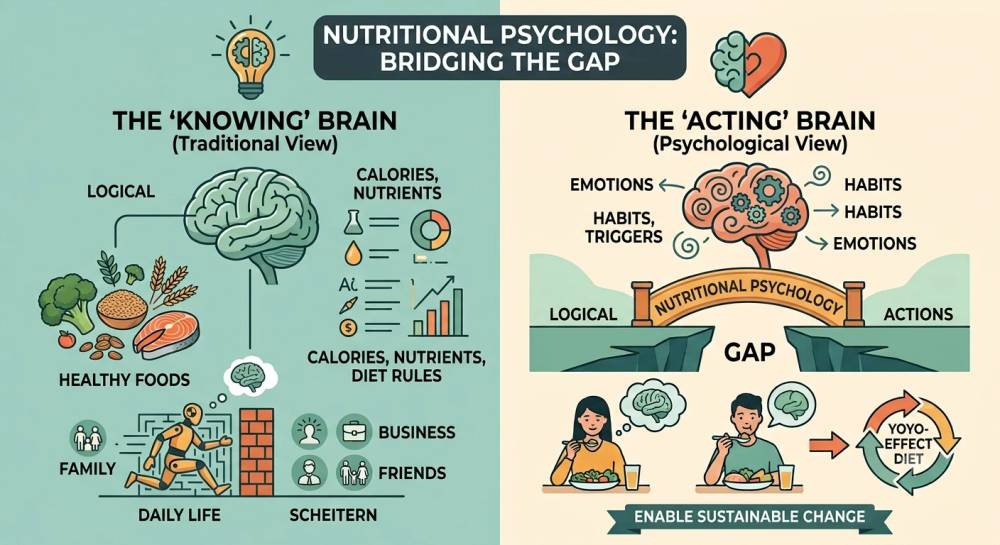
You already know exactly what you should be eating. And yet, after a long day, you still find yourself reaching for the chocolate.
It is not a lack of knowledge holding you back. It is the subconscious interplay of suppressed emotions, deep-seated habits, and outdated dietary mindsets.
This exact crossroad is where nutritional psychology comes in. While traditional nutritional counseling tells you what should be on your plate, a nutritional psychologist helps you understand why it feels so difficult to follow through consistently.
The Gap Between Knowing and Doing: Why Strict Diet Plans Fail
We live in an era of information overload. Almost everyone understands that vegetables are good for us and that ultra-processed foods should not form the foundation of our daily diet.
Yet, traditional meal plans almost always crash against the reality of daily life. Nutrition does not happen in a laboratory. It happens in real life.
In my daylife, I have repeatedly observed that pure nutritional education completely fails when emotional eating patterns are involved. When stress, loneliness, or burnout join you at the dinner table, no macro calculator in the world can help. Willpower is an exhaustible resource - psychological insight, on the other hand, creates lasting freedom.
When you reach for comfort food after a grueling day at work, you are not fighting physical hunger. You are trying to satisfy an emotional need. Imposing a rigid set of food rules onto that moment only increases stress, inevitably leading to guilt and shame.
What Does a Nutritional Psychologist Actually Do?
A nutritional psychologist bridges the gap between physiological nutrition science and behavioral psychology.
1. Identifying Emotional Eating Patterns & Triggers
Together, you analyze the specific situations in which you turn to food without feeling physical hunger. The goal is to break automated behavioral feedback loops and establish healthy, alternative coping mechanisms for emotions like stress, sadness, or boredom.
2. Dissolving Mindsets & the "Diet Mentality"
"I should not eat carbs after 6 PM" or "I ruined my diet, so I might as well give up today" - these internalized rules create constant internal conflict. Nutritional psychology helps you dismantle these rigid prohibitions and rebuild a relaxed, intuitive connection with food.
3. Sustainable Behavioral Change Over Short-Term Discipline
Instead of relying on sheer willpower, you focus on sustainable habit formation. You learn to tune back into your body's innate physiological signals - like genuine physical satiety and true hunger - rather than letting external diet trends control your choices.
The DGE Perspective: Why Physiology and Mindset Must Work Together
Focusing solely on psychology is just as incomplete as focusing purely on biochemistry. A healthy body requires both proper physical nourishment and mental balance.
According to official DGE (German Nutrition Society) guidelines, optimal health is built on a wholesome, nutrient-dense, and balanced selection of real foods. However, these physiological foundations can only yield results if your psychological foundation is grounded.
When blood sugar swings caused by erratic meals collide with unmanaged emotional stress, a vicious cycle of cravings and exhaustion takes over. Sustainable coaching must integrate biological facts with behavioral psychology.
When Do You Need Nutritional Psychology Support?
Not everyone looking to eat healthier needs psychological guidance. However, clear warning signs indicate when traditional nutrition advice has hit its limit.
- You are trapped in the yo-yo diet cycle: You have tried countless diets, only to regain the weight as soon as the program ends.
- Food is your primary emotion regulator: You systematically use food to cope with stress, overwhelm, loneliness, or frustration.
- You experience persistent food guilt: After eating certain foods, you feel instant remorse or the urge to "punish" yourself with restriction.
- Food thoughts dominate your day: You constantly plan meals, obsessively track calories, or feel ongoing anxiety around social eating.
- You have lost touch with physical hunger: You can no longer reliably tell when you are truly hungry versus when you are full.
What Does This Look Like in Practice?
Working together is never about receiving a rigid shopping list or being told what you are doing "wrong." It is an active, collaborative partnership.
A client came to me because she binged on sweets every single evening, despite eating "perfectly clean" during the day. We did not ban her evening chocolate. Instead, we removed her extreme daytime restriction and taught her to process evening emotional fatigue without food. Within six weeks, the binges stopped naturally - without feeling deprived.
You develop a deep awareness of your unique behavioral triggers. Through tailored exercises, mindfulness techniques, and cognitive-behavioral tools, you systematically build a calm, resilient relationship with food.
Common Misconceptions: Psychotherapy vs. Holistic Nutrition Coaching
It is vital to establish a clear distinction: Nutritional psychology coaching is not psychotherapy.
Important Note: If you are dealing with a diagnosed clinical eating disorder (such as anorexia, bulimia, or binge eating disorder) or clinical depression, formal medical treatment and psychotherapy are required. Holistic nutrition coaching can only act as a supportive secondary service in explicit coordination with your treating physician.
In cases of suspected clinical eating disorders, evaluation by a qualified medical specialist or psychotherapist should always be recommended.
Holistic nutrition coaching is designed for healthy individuals who suffer from a stressful, disordered, or diet-obsessed relationship with food and want to regain peace, energy, and freedom.
Your Next Step Toward a Peaceful Relationship With Food
Understanding the theory is a great start, but real transformation happens when you apply these principles to your unique daily life.
To understand how your mindset directly shapes your eating habits, explore our central guide on the Psychology of Eating (soon available).
Wondering how to choose the right professional support for your personal journey? Read our practical guide on how to find the right nutrition professional for your goals (coming soon).
You do not have to force results through endless willpower. If you are ready to resolve the root causes of your eating habits and build a sustainable, nourishing lifestyle once and for all, let us talk.
In my 12-week 1:1 coaching journey, we combine science-backed nutrition with deep behavioral psychology - tailored entirely to your life.