
The Vessel
5-4-3-2-1 Method: Is this nutrition framework the key to your success?
You’re standing in the kitchen after a long day, and the only question that feels like a heavy burden is: "What can I eat now that’s healthy but doesn't stress me out even more?"
Most diets don't fail because of a lack of willpower, but due to what we call decision fatigue. When every meal becomes a complex math problem involving calories, macros, and restrictions, our brains eventually tune out. This is where the 5-4-3-2-1 method comes in. It promises structure through simple numbers rather than complicated apps. But does this framework stand up to clinical scrutiny, or is it just another trend ignoring your body's individual needs?
What exactly is the 5-4-3-2-1 method?
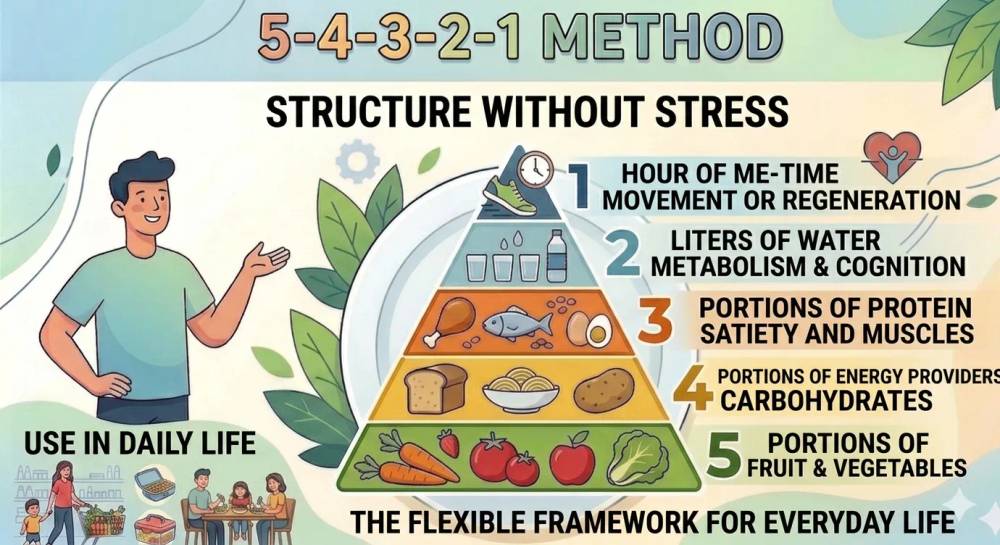
At its core, the 5-4-3-2-1 rule is a visual and numerical framework designed to balance daily nutrient intake and lifestyle without tracking every single gram.
The classic breakdown usually looks like this:
- 5 Portions of Fruits and Vegetables: The foundation for micronutrients and fiber.
- 4 Portions of Carbohydrates: Energy sources like whole grains, potatoes, or pseudo-cereals.
- 3 Portions of Protein: Building blocks for muscles and hormones (animal or plant-based).
- 2 Liters of Water: The basis for metabolism and cognitive performance.
- 1 Hour of Movement or Me-Time: A focus on physical and mental regeneration.
This system acts as a guardrail. It doesn't tell you what you can't eat; instead, it shows you where to direct your focus to fuel your body functionally.
Why our brains love simple rules (and hate diets)
Psychologically speaking, the 5-4-3-2-1 method is a blessing for your working memory. While traditional diets are based on restriction ("Cut this out!"), this framework relies on the principle of crowding out. When you are busy fitting in your 5 portions of vegetables and 3 portions of protein, there is naturally less room for highly processed foods—without you feeling like you are actively sacrificing anything.
In my coaching, I often see women who can't see the forest for the trees. They know everything about Omega-3s and insulin spikes, but they fail at the basics. A simple number system like 5-4-3-2-1 lowers the cognitive hurdle so much that the system actually works on stressful days when there’s zero capacity for a tracking app.
The Clinical Check: How scientific is the rule?
As a certified nutritionist, I always view these trends through the lens of evidence-based recommendations. The good news: the 5-4-3-2-1 method aligns largely with the established guidelines of major nutritional societies (like the DGE in Germany).
The "5-a-day" rule for vegetables and fruits has been the gold standard for preventing diet-related diseases for decades. Similarly, the emphasis on hydration (2 liters) and movement (1 hour) correlates strongly with official health mandates. However, it becomes critical when we look at individuality. A 5'3" office worker has different needs than a 5'11" woman lifting weights three times a week. Using a "portion"—usually defined as your own handful—as a unit of measurement is a clever, albeit imprecise, compromise.
Why this method is a game changer for busy women
This framework is ideal for women navigating a demanding daily grind. If you’re juggling children and a full-time job and have no desire to operate a kitchen scale in the evening, the 5-4-3-2-1 rule provides the necessary safety net.
It specifically helps with:
- Not underestimating protein needs (the "3"), which is essential for satiety.
- Maintaining a focus on fiber (the "5") to prevent cravings.
- Ensuring hydration (the "2") doesn't become an afterthought.
One of my clients, a senior executive, was completely exhausted by the constant monitoring of her calorie app. We switched to the 5-4-3-2-1 principle, specifically tailoring the "3" (protein) to her vegetarian lifestyle. After two weeks, she reported that for the first time in years, she just "ate" without her head constantly doing math—and her energy levels stayed stable through the afternoon slump.
Where the 5-4-3-2-1 rule hits its limits
Despite its advantages, this system is not a cure-all. It is a mechanical tool, not a psychological one. If you struggle with emotional eating or have deep-seated beliefs about your body, even a 5-4-3-2-1 structure won't save you from cravings triggered by stress or loneliness.
Furthermore, the rule often neglects food quality. Theoretically, 4 portions of white bread are "on plan," but they have a completely different effect on your blood sugar than 4 portions of quinoa or oats. This is where supplementary knowledge about nutrient density is required.
Conclusion: A tool, not a prison
The 5-4-3-2-1 method definitely delivers results if you view it as a flexible scaffold rather than a rigid law. It takes the pressure out of eating and gives you back autonomy over your plate.
However, if you notice that despite this structure, you aren't reaching your goals—whether regarding weight, energy, or overall well-being—the problem usually lies deeper than the mere distribution of portions. Often, hormonal imbalances or unconscious behavioral patterns require a more individualized look.
Want to know which deeper mechanisms are influencing your results? Check out how a systematic approach to nutrition can sustainably change your outcomes, or learn the 5 key nutrition concepts that go beyond simple numbers.
Your next step toward ease
Knowledge alone doesn't create change. You now know the theory behind the 5-4-3-2-1 method, but the art lies in weaving it into your life so it doesn't feel like work. If you're tired of "one-size-fits-all" formulas and want a strategy that respects your hormones, your psyche, and your calendar, let's talk.
In my 12-week 1:1 journey, we don't develop a cookie-cutter plan, but rather your personal operating system for more energy and well-being. Because I only work with a limited number of clients at a time, spots are reserved exclusively for those ready for real, sustainable transformation.